It Started With Four Words
"I can't hear anything."
I must have heard those words a few hundred times over the years, always at the worst possible moment. Boom in the air, camera rolling, whole crew holding its breath, and then the director yells that they can't hear a thing on comms. Nine out of ten times it wasn't a technical problem at all. Somebody, almost always a director, had switched off their own receiver at some point and forgotten. But you couldn't just glance at it and know. The receiver lived inside a little fabric pouch, and the only way to actually troubleshoot it was to pull it out first. And in a situation like that, the time it takes to finally figure out what is wrong feels like a lifetime. (To all the people who read this and think to themselves, "just tell them to wait": yeah, on some shoots that works. On others, that is not an option. I'm speaking from experience. Right now it is exactly 30 years since I started in the movie industry as an 18 year old sound guy with my dad.)
That pouch came standard with every Sennheiser G2, G3, and G4 IEM Bodypack receiver, and I think every sound person who's used one has a story about it. You had to thread the belt clip through this narrow slit in the fabric, and it jammed constantly. Eventually Sennheiser just stopped selling them, and the ones still floating around sets slowly disappeared, one production at a time. Some crews solved this their own way: they just stopped using the pouch at all and carried the receiver bare. That fixed the fumbling, but created a new problem, because now the receiver had zero protection, and unprotected receivers get dropped. Almost always by directors. Never by script supervisors, as far as I could tell.
So for years we were stuck choosing between two bad options. A pouch that made troubleshooting a small ordeal, or no protection at all.
Two years ago this month, after one more of those moments, I finally sat down and opened my CAD software. I wasn't trying to start anything. I just wanted a case good enough to get me through the next job without another "I hear nothing" disaster. The first thing that came off the printer was this loud neon green block, rough print lines everywhere, antenna wire held in place with a strip of tape. I wasn't even that happy with it. I figured it would do for now.
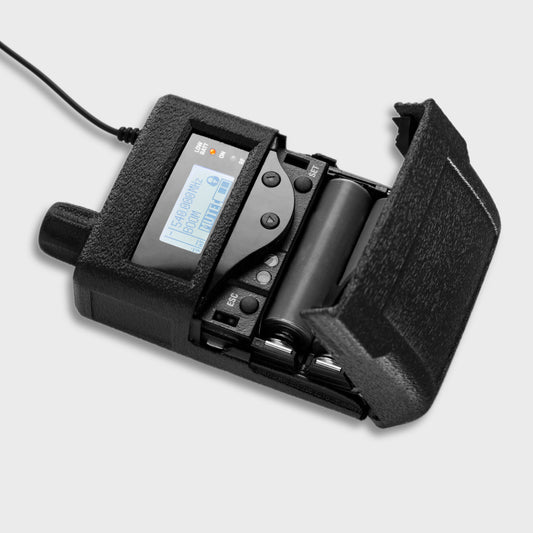
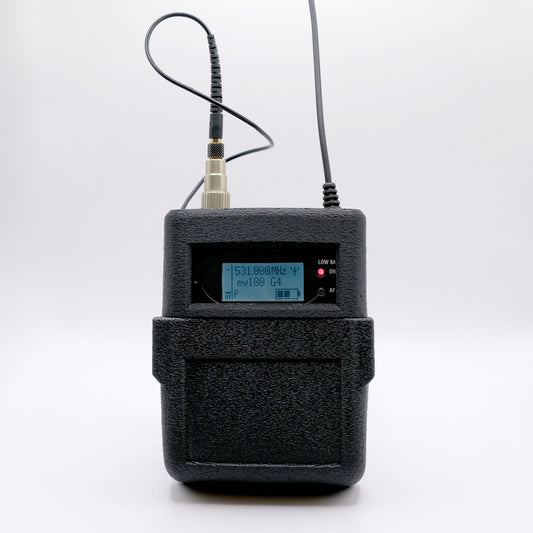
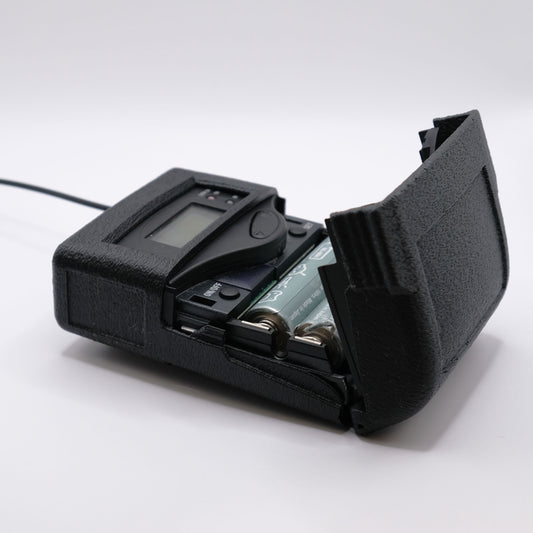
Except it didn't stop there. I got completely sucked into the idea. I kept going back to the computer, tweaking the shape, printing another version, tweaking it again. Prototype after prototype, until one day I had something that looked a lot like the CrabShell we sell today: a case you put on once and never have to take off again, with the battery door and buttons still fully reachable.
I'd mentioned the idea to my brother Jonas along the way, but he hadn't actually seen it yet. When I finally showed him, he was blown away. He told me straight up that he hadn't expected it to look anywhere near as good as it did.
The timing lined up almost perfectly. I was about to start block 2 of the remake of the Swedish classic, Astrid Lindgren's Seacrow Island after the summer break, and Jonas was heading into his own production, My Name Is Agneta. We agreed I'd run the prototype on my set, he'd run it on his. We didn't need long on either production before we both landed on the same thought: this isn't just something we built for ourselves. This is a product.
That led to a bigger question than I expected. Do we build this under Ljudfadern, our existing sound company, or do we start something completely new to keep it clean? We went back and forth for a while and eventually decided a new company made more sense. Starting a Swedish aktiebolag costs money, though, and it's easy to stay comfortable doing the thing you already know how to do, which for us was recording sound for a living. But we decided to just go for it.
Then came the part that took longer than either of us expected: what do we even call this thing? We knew early on we wanted a crab as the logo, partly because a crab has a hard shell, which felt fitting, and partly because Jonas and I have always had a soft spot for the blocky little 8-bit and 16-bit crabs that show up in old video games from the 80s and 90s. We spent a long time down that road, throwing out crab-related name after crab-related name. Nothing stuck.
Then I remembered a scene from The Simpsons. Homer's stuck by his car in New York, and buys some food from a street vendor. I won't spoil it for you, just watch it:
CrabJuice. It had absolutely nothing to do with protective cases for wireless audio gear, and that was exactly why it worked. A name that strange sticks in people's heads. So that's what we became: CrabJuice Accessories.
We handled the legal side of setting up a company, put together a Shopify store, and opened for business sometime in December 2024, though we count December 25th as our actual start date. Two days later, on the 27th, our first order came in, to a customer in France. It felt genuinely magical. A few hours after that, a second order landed, this time to Spain. It's kept rolling ever since, and two years after that first ugly green prototype, we're still building on the same idea: put it on, leave it on.
If you've ever bought a CrabShell for your Sennheiser IEM bodypack receiver, thank you. All of you, really. None of this happens without you.